Renault Trucks decarbonises its industrial logistics
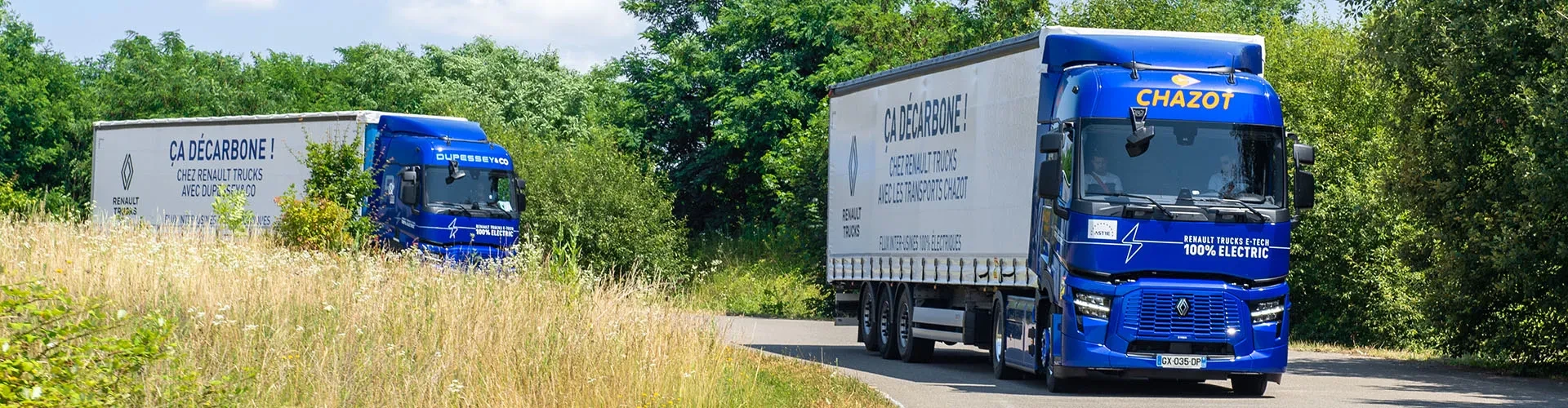
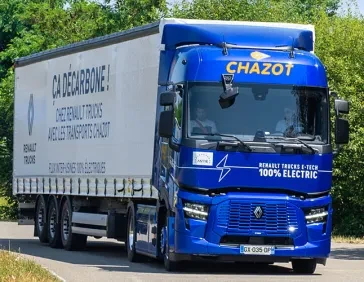
Renault Trucks is continuing to reduce the carbon footprint of its inter-factory flows. Following a successfufirst deployment between Lyon-Vénissieux and Bourg-en-Bresse, the manufacturer is now rolling out an electric logistics corridor linking these sites with its Blainville-sur-Orne plant. This initiative demonstrates Renault Trucks’ determination to apply to its own operations the low-carbon solutions it offers to its customers. Overall, 4 million kilometres will be travelled annually using electric trucks, reducing CO₂ emissions by 3,000 tonnes.
A further acceleration in the electrification of logistics flows
In 2024, Renault Trucks launched the electrification of a first strategic logistics route linking its Lyon-Vénissieux (Rhône) and Bourg-en-Bresse (Ain) production sites. Five electric trucks replaced diesel vehicles for transporting axles used in the assembly of vehicles manufactured in Bourg-en-Bresse.
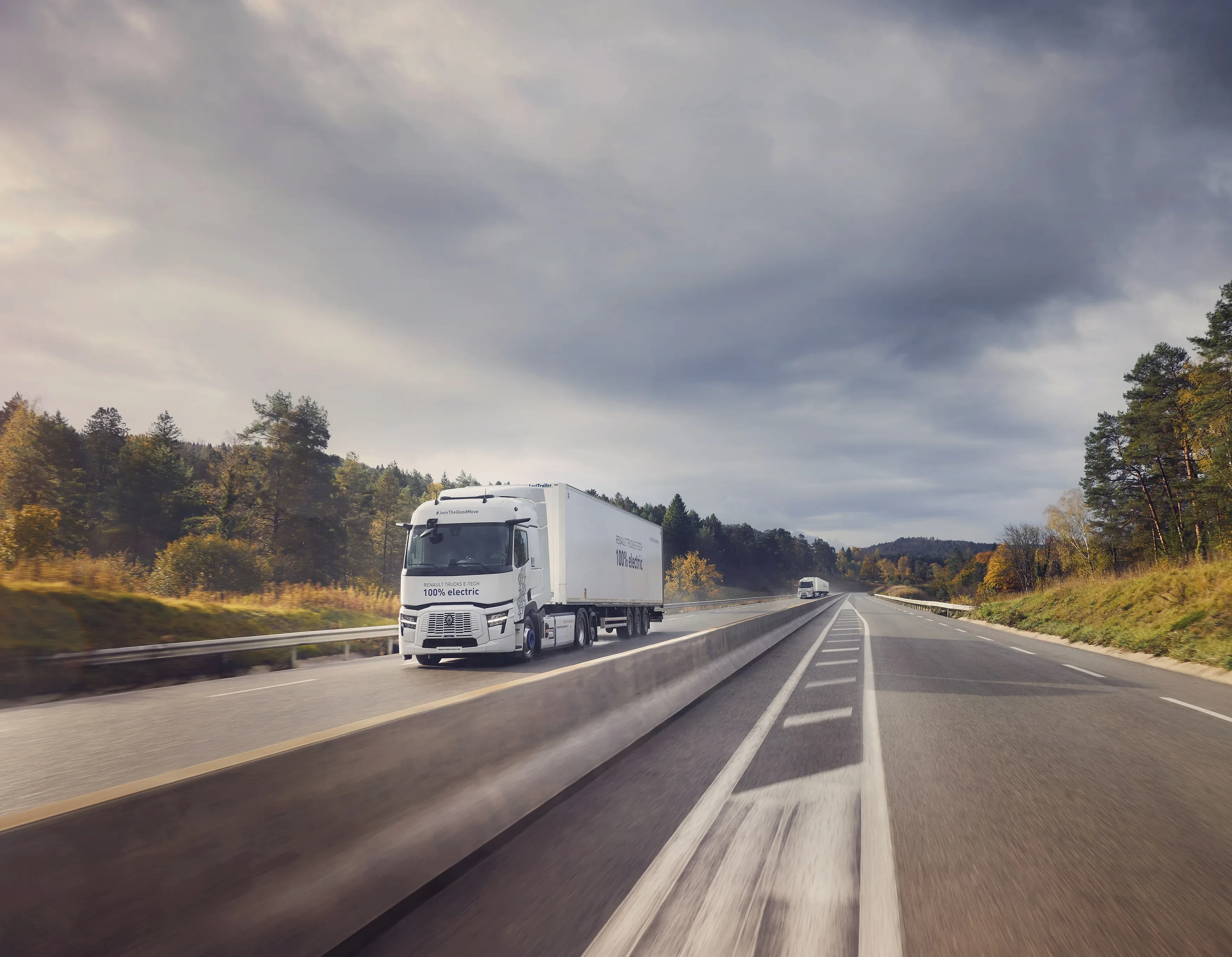
Building on this initiative, Renault Trucks introduced an ambitious electric logistics corridor at the end of 2025 connecting Blainville-sur-Orne (Calvados), Bourg-en-Bresse and Lyon-Vénissieux. Twenty-two electric trucks now transport cabins produced in Blainville-sur-Orne to Bourg-en-Bresse, where the company’s heavy-duty vehicles are manufactured. On their return journeys to Normandy, the electric trucks carry engines and axles produced in Lyon-Vénissieux for the assembly of mid-range vehicles.
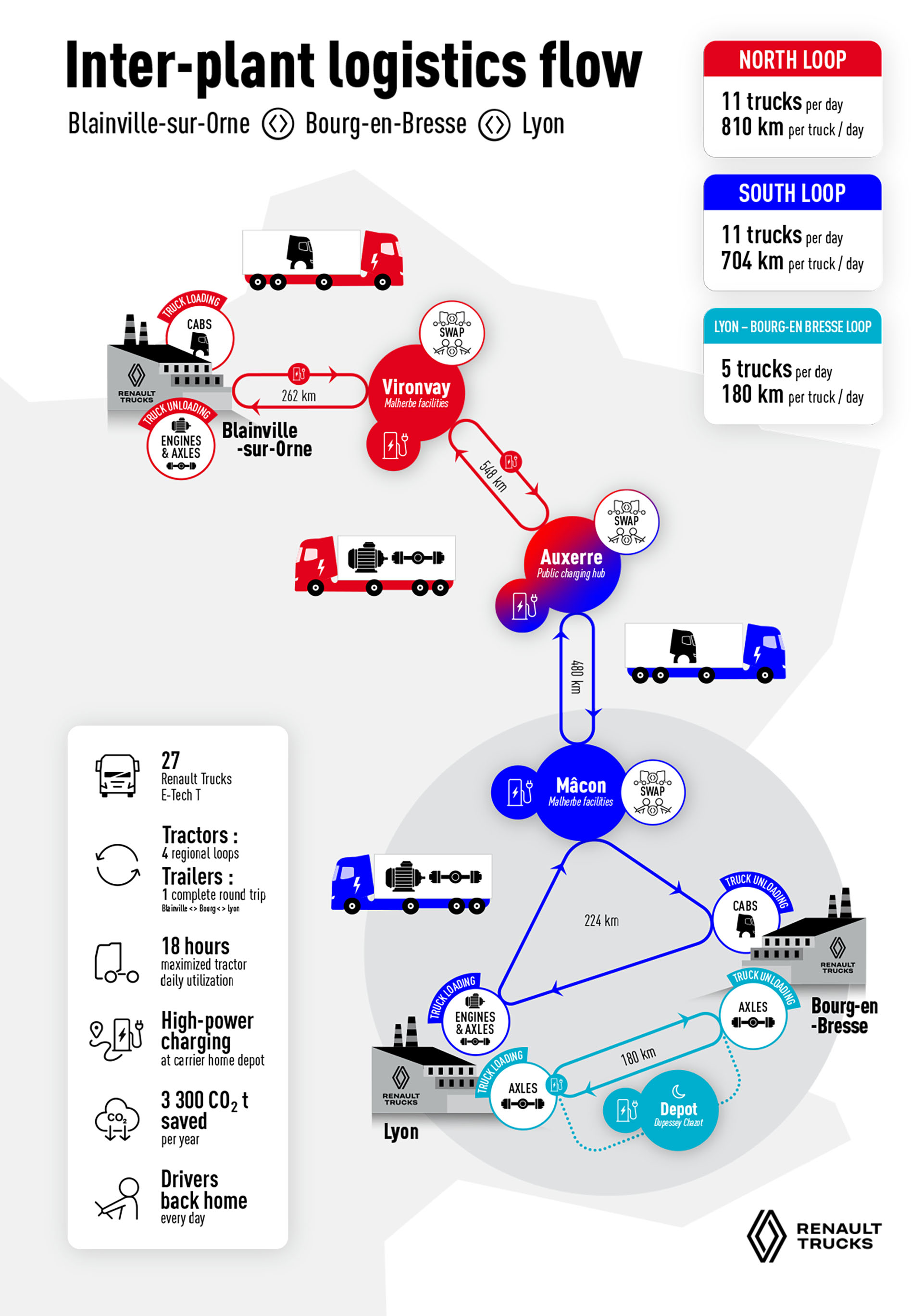
These logistics operations support critical industrial flows running on a just-in-time basis. They account for more than 4 million kilometres travelled annually by electric trucks, preventing the emission of 3,000 tonnes of CO₂.
A logistics model designed for long-distance electric transport
To address the range constraints associated with electric trucks while ensuring continuity of industrial flows, Renault Trucks has introduced a relay-based operating model along its electric logistics corridor connecting Normandy and the Auvergne-Rhône-Alpes region. Drivers and trailers are exchanged at strategic points along the route.
This organisation enables:
- vehicle utilisation of up to 18 hours per day;
- charging operations to be integrated into mandatory driver rest periods;
- distances of up to 810 km per truck per day, depending on the route;
- drivers to operate close to their place of residence.
Regional logistics flows between Lyon-Vénissieux and Bourg-en-Bresse rely on a simpler operational model, with vehicles being charged during mandatory driver breaks at Renault Trucks facilities and overnight at the depot.
Large-scale proof of the maturity of electric trucks
By electrifying its own industrial flows, Renault Trucks is demonstrating the maturity, reliability and relevance of electric heavy-duty vehicles under real operating conditions. Electric mobility solutions are proving capable of meeting the most demanding requirements of industrial logistics, particularly with regard to operational pace, precision and continuity of flows.
The manufacturer is now pursuing this transformation with the ambition of fully electrifying its logistics operations by 2030.