MODERN SLAVERY STATEMENT 2025
Renault Trucks is a Lyon, France based company which manufacturers, markets, imports and sells trucks in 130 countries around the world. Renault Trucks is a large multi-site enterprise with in excess of 7 937 employees spread across circa 4 sites across the country.
Structure, business and supply chain
Renault Trucks is a member of the Volvo Group. The Volvo Group is a publicly held company headquartered in Gothenburg, Sweden. The Volvo Group is one of the world’s leading manufacturers of trucks, buses and construction equipment as well as power solutions for industrial and marine engines. The Volvo Group also provides complete solutions for financing and service. In 2025, the Volvo Group’s sales amounted to about SEK 479 billion. The Volvo Group sells the majority of its products under the Volvo, Volvo Penta, Rokbak, Renault Trucks, Prevost, Nova Bus and Mack brands. We also have ownership in Milence, Eicher, Dongfeng, cellcentric, Flexis, Cespira and Coretura, among other companies. By offering products and services under different brands, we address many different customer and market segments around the world.
The Volvo Group employs 99,000 people worldwide, has production facilities in 17 countries and its products are sold in almost 180 markets. The most significant manufacturing operations are located in Sweden, the United States, France, Brazil, Belgium and Canada.
The Volvo Group depends on global and local supply chains to deliver components, parts and complete services and systems. Approximately 12,000 suppliers support the Volvo Group’s serial production and in total the Group’s supply network comprises more than 50,000 suppliers globally in tier 1. Our visibility into the supply network is strongest in tier 1, and typically decreases further upstream as supply chains become more complex.
In 2025, the Volvo Group made purchases of goods and services totalling SEK 328,1 billion. We annually source 2.5 billion parts to be delivered to Volvo Group plants globally. The longest, most complex and globally spanning supply networks are generally associated with electronics, including battery and other electric vehicle components.
Bulk material such as steel, aluminium and polymers generally have regional supply chains. Sustainability impacts related to these materials can arise in extraction and refinements of materials in a range of tiers. We have identified certain materials in parts and components which are considered high risk from a social and environmental perspective, including, for example, tin, tantalum, tungsten, gold, cobalt, and mica. The identification of such materials informs our assessment of where enhanced due diligence may be needed in the supply network, in line with our risk-based approach. We keep our assessments of the materials we source under continuous review to help identify those where additional due diligence activities of our supply partners and network may be necessary (e.g. due to regulatory changes). We are continuously making strides to strenghten supply network transparency in the value chain in which we operate, for example by conducting supply chain audits on components of strategic importance.
Human Rights Governance
The Volvo Group is committed to respecting internationally recognized human rights. Negative human rights impacts may potentially materialize not only within our own organization, but also through our business relationships and in our value chain. We seek to address adverse human rights impacts with which the Volvo Group is involved. We are continuing to strengthen our human rights due diligence processes in line with the following international frameworks:
- UN International Bill of Human Rights
- ILO’s Core Conventions
- UN Global Compact
- UN Guiding Principles on Business and Human Rights
- OECD Guidelines for Multinational Enterprises
- Children’s Rights and Business Principles.
The Volvo Group Human Rights Policy sets the threshold for and establishes our commitment to embed human rights due diligence into the business, in line with international frameworks. The policy sets out our commitment to undertake human rights due diligence using a risk-based approach across our own operations and the relevant parts of our value chain including our supply chain, and our downstream business relationships. It applies to all Volvo Group entities, employees and others working at our sites. The Human Rights Policy is complemented by the Volvo Group’s Code of Conduct, the Volvo Group’s Human Rights Program and specific policies, directives and guidelines developed by our Divisions and Business Areas in several human rights-related areas. These include health and safety, responsible purchasing through our Supply Partner Code of Conduct, human resources, responsible sales and whistleblowing. The Volvo Group’s human rights governance follows our allocation of business accountability and includes several cross-functional governance forums and working groups, led by a Human Rights Board comprised of relevant members of our Executive Board. The Human Rights Board is responsible for overseeing and directing the Volvo Group’s human rights work. Implementation of the Human Rights agenda is supported by a cross-functional coordination group and several working groups with members from relevant Group Functions, Divisions and Business Areas.
The Volvo Group has a Human Rights Program which operationalizes our policy commitments and defines minimum standards on human rights management and reporting obligations for our divisions and business areas. The Human Rights Program describes our strategy, governance, roles and responsibilities, supports the Volvo Group in systematically identifying, mitigating and addressing human rights risks and facilitates continuous improvement in our processes. The Human Rights Program is overseen by the Volvo Group Human Rights Board. Operationally, the program is led by our Group Function Corporate Responsibility together with representatives of our Divisions, Business Areas and other Group Functions. In 2025 we concluded a Volvo Group-wide human rights risk and maturity assessment commenced during 2023. The analysis enabled us to identify existing good practice in our management systems as well as opportunities for improvements. With the result as a baseline, we are working continuously to address our priority gaps and strengthen human rights due diligence processes. As a result of the project, we have updated our salient human rights risks and established a number of priorities for further improvement, including increased focus on downstream due diligence and strengthening our human rights governance. With this, we have also developed internal tracking and reporting of potential incidents. This process involves relevant functions, divisions and business areas to report cases for central assessment led by the central human rights program lead. Development of this reporting process is part of the continuous improvement of human rights due diligence.
Policies including statements relating to modern slavery
Volvo Group Code of Conduct
Non-tolerance of forced labor and child labor has been part of the Volvo Group Code of Conduct since 2003. The Code of Conduct applies to everyone who works for or on Volvo Group’s behalf, including full- and part-time employees, consultants, temporary staff, managers and the boards of directors of Volvo Group companies. The Volvo Group Code of Conduct states that we do not tolerate any forms of modern slavery, including practices such as forced labor, debt bondage and human trafficking. The Code of Conduct includes examples of modern slavery related practices such as confiscation of identity papers or passports, withholding of wages, not conferring an official employment status, subjecting someone to physical and sexual violence, debt bondage, imposing recruitment fees, and restricting people’s freedom of movement. The Volvo Group Code of Conduct is available in fifteen different languages. All employees are required to undertake mandatory e-learning on the Volvo Group Code of Conduct on an annual basis. The Volvo Group Code of Conduct is publicly available on Volvogroup.com.
Volvo Group Human Rights Policy
The Human Right’s Policy states our commitment to respect internationally recognized human rights and to avoid causing or contributing to adverse impacts as stated in the UN Guiding Principles on Business and Human Rights. The Human Rights Policy applies to all Volvo Group entities, employees and others working at our sites.
The policy states that the Volvo Group does not tolerate any form of modern slavery and child labor in our own operations and our supply chain. The Volvo Group Human Rights Policy is publicly available on Volvogroup.com.
Supply Partner Code of Conduct
Since 1996, our Responsible Purchasing Program has consistently increased supplier requirements on environmental performance, business ethics and human rights. Since 2019, suppliers are required to commit contractually to comply with the Supply Partner Code of Conduct.
The Supply Partner Code of Conduct states that the Volvo Group does not tolerate any forms of modern slavery, including but not limited to forced, bonded or compulsory labor and human trafficking or child labour. The Volvo Group requires Supply Partners, including their recruitment agencies, not to engage in or tolerate restriction of movement, recruitment fees, confiscation of identity documents and/or working passports, withholding of wages, abusive working conditions, debt bondage, violence or any other kind of exploitation or abuse, and to prevent all forms of child labour and respect children’s rights to development, play, and education. Supply Partners shall have adequate policies, risk awareness, risk assessment and due diligence processes in place to prevent modern slavery and forced labor, including remediation plans addressing situations if modern slavery or forced labor is detected. Supply Partners are also encouraged to engage constructively with relevant stakeholders such as non-governmental organisations and industry associations to build awareness and proactively work towards preventing modern slavery and forced labor.
Supply Partners are required to ensure that all Requirements1 of the Supply Partner Code of Conduct are upheld in their own operations and in their full value chain. The Volvo Group also expects all our Supply Partners to integrate, share and promote the Expectations2 of the Volvo Group Supply Partner Code of Conduct internally and throughout their entire supply network.
All Supply Partners are required to perform due diligence in the areas covered by the Supply Partner Code of Conduct and/or applicable laws and regulations, including for the purpose of investigating and evaluating the integrity, quality, suitability, and credibility of all its potential business partners. Supply Partner’s due diligence efforts shall be in line with international standards such as the OECD Due Diligence Guidance for Responsible Business Conduct and the UN Guiding Principles on Business and Human Rights. Supply Partners shall include impacts of its own operations and its supply network with a focus on where it has the highest risks of doing harm, and appropriate to company size and circumstances.
The Supply Partner Code of Conduct and the associated sustainability performance is a key indicator in the Volvo Group Supply Partner qualification and assessment process, and accepting the Supply Partner Code of Conduct is a prerequisite to doing business with the Volvo Group. We reserve the right to audit the Supply Partner and its network at any point during the contract period. Lack of cooperation and failure to address violations may result in reduction of business and, ultimately, an end to the business relationship with the Volvo Group. The Supply Partner Code of Conduct is publicly available at Volvogroup.com.
Sustainable Materials Sourcing and Due Diligence Policy
In 2025 we introduced a Sustainable Materials Sourcing and Due Diligence Policy. This policy is based on internationally recognized human rights and labor standards and is intended to facilitate compliance with applicable legal regulations in our sourcing practices. It reinforces our expectations for traceability, responsible sourcing, and robust risk assessment across the supply chain, complementing the Supply Partner Code of Conduct. The Sustainable Materials Sourcing and Due Diligence Policy is publicly available at Volvogroup.com.
Materiality and impact assessments
The Volvo Group conducts a double materiality assessment each year to help us evaluate impacts, risks and opportunities associated with sustainability topics, including assessing scope and scale for such impacts and ways to mitigate or remediate negative effects. Volvo Group also perform risk assessments that may be based on input from e.g. salient human rights assessments.
Volvo Group disclosures of material topics follow the European Sustainability Reporting Standards (ESRS) methodology where material risks related to forced labour and child labour are embedded into the different reporting topics, including own workforce, workers in the value chain and affected communities.
In 2025, our main sustainability related impacts, risks and opportunities in our upstream value chain are workersʼ rights, environmental impacts from extraction and refinement of materials in purchased goods, and human rights impacts from the sourcing of materials with elevated risks. For our downstream value chain, we have identified potential impacts on communities in particular related to sales to military end-users, sales of militarized products, sales to high-risk sectors and sales in Conflict Affected and High-Risk Markets. In relation to affected communities, forced labour and child labour was identified as a potential impact. Modern slavery has not been identified as a salient risk within our own operations or in relation to consumer and end-users.
To understand and address sustainability matters, including human rights, we conduct double materiality assessments informed by our saliency analysis performed within our Human Rights Program. These help us evaluate the impacts, risks and opportunities associated with each topic. Risks and opportunities have been identified by analysing actual risks and considering various theories on future developments, covering short-, medium-, and long-term risks. For areas where there is high uncertainty, the process includes scenarios that explore potential outcomes. These scenarios have been developed by a network of sustainability professionals from different areas within the Volvo Group. In certain cases, particularly in relation to human rights impacts in upstream and downstream activities, the likelihood of impacts is highly uncertain. In these cases, the severity of potential impacts is prioritized over other factors (such as likelihood) in the materiality assessment. An example is forced labor and child labor in the value chain, which is complex to identify or to ascribe likelihood to. As part of the assessment, we perform internal controls to ensure that both quantitative and qualitative data is relevant and accurate. Decisions on matters considered as material for the Group are then taken in a steering committee with representatives from the Executive Board. The process is overseen by the Audit Committee of the AB Volvo Board.
The materiality assessment for our own workforce covers all employees and consultants in the Volvo Group. We have reviewed details such as remuneration, employment practices, coverage of benefits related to social protection, whistleblower reports and more. The impacts we have concluded as the most important for our workforce are health and safety, diversity, equal treatments and opportunities, social dialogue and collective bargaining and non-discrimination.
The materiality assessment for workers in the value chain is informed by due diligence activities, including supplier self-assessments, on-site audits, grievance reports, and external data sources. Given the size and complexity of Volvo Groupʼs supply chain, primary data on workers beyond first and second tier suppliers is limited. As a result, materiality assessments further upstream rely largely on proxy data related to human rights and environmental risks across geographies, commodities, and business activities. Key human rights risks identified include forced labor, child labor, and broader labor rights issues such as working conditions, adequate living standards, safety, non-discrimination, and access to remedy. In these assessments, we prioritize the countries and purchase segments where we believe that we have the highest risks for adverse human rights impacts, using data from credible third-party service providers on modern slavery risks in different countries.
For affected communities, our approach to assess and address impacts on affected communities is continuously developing. We have so far identified certain areas of priority, such as risk of adverse impacts when products are misused, particularly in high-risk contexts.
In the establishment of new Volvo Group operations (e.g. factories), we have identified risk proactively and applied mitigation measures. To date, these types of investigations have been carried out ad hoc depending on the case at hand.
As part of our risk assessments across these different areas, we have held discussions with experts from external organizations such as civil society organisations and NGOs to capture input from perspectives of stakeholders who may not turn to Volvo Group directly for advice or grievance escalation. Dialogues and consultations with certain stakeholder groups are more formalized while others are carried out ad hoc.
In 2025, we reviewed the materiality assessment by focusing on the Volvo Groupʼs enterprise risk management reporting, events and occurrences anticipated to trigger a new assessment, and new insights from updated due diligence processes. The materiality assessment process will continue to be developed over time, which may lead to additional impact, risks and opportunities being identified as material.
In the process of evaluation of impacts, we have considered actual measured impacts, as well as potential impacts that are likely to occur in our operations or value chain. For impacts related to workers in the value chain, we have used primary data from site audits and reviews. We have also included data from risk mapping in relation to human rights in the value chain, which has presented geographical as well as thematical hotspots of risks.
Due diligence
Workers in the value chain
We perform risk-based due diligence across our value chain, encompassing suppliers, contractors, service providers, distributors, dealers, importers, business partners and customers. Our due diligence activities primarily seek to prevent and mitigate material negative impacts through supply network controls and verification processes.
We perform sustainability assessments which focus primarily on tier 1 supply partners and are conducted through supply partners’ self-assessments as well as targeted in-depth onsite audits. We prioritize audits based on sustainability risks by country, commodities, processes or work areas, and consider all thematic risks covered by the Supply Partner Code of Conduct. Risks can be flagged during audits, training, site visits or via Volvo Group’s grievance mechanism. The Volvo Group carries out most audits and reviews with internal resources. Purchasing staff and specialized auditors help to ensure that gaps are addressed and documented in corrective action plans. Volvo Group also has responsible sales processes in place that focus on human rights. This area has been a priority to strengthen.
We strive to consider the human rights of groups that may be especially vulnerable or marginalized. Related to our business activities, vulnerable groups include people in conflict areas, women, young workers, and migrant workers. As we enhance our human rights due diligence, we aim to integrate a specific focus on vulnerable groups.
Self-Assessments: Volvo Group’s screening process with direct suppliers begins with the sustainability self-assessment questionnaire (SAQ), which provides valuable insights into a potential supply partnersʼ regulatory compliance and responsible business practices. The SAQ is a standardized questionnaire developed by DRIVE Sustainability (an automotive partnership facilitated by CSR Europe), covering human rights, working conditions, environmental and responsible supply chain management. SAQ responses are validated by a third-party organisation on behalf of DRIVE Sustainability and results inform partner selection, risk prioritization and corrective action plans. Assessments are valid for three years, and the SAQ itself is updated regularly to address evolving regulatory requirements and to drive continuous improvements. In 2025, a total of 2,921 sustainability self-assessments were performed, which is a decrease compared to 3,547 assessments in 2024. This decrease reflects year-on-year variation driven by the timing of assessment renewals, level of new sourcing activities, and targeted assessment activities undertaken in 2024. From a total Volvo Group direct material spend perspective, 93% of all supply partners have conducted the assessment. Of those assessed, 86% were conformant with our SAQ requirements. In high-risk areas, the corresponding result was 94% completion, out of which 87% were conformant with our SAQ requirements.
Sustainability Audits: In addition to self-assessments of supply partners, we conduct additional risk analysis of potential supply partners of direct materials in high-risk countries, including onsite audits during the sourcing phase. Similarly, potential supply partners of indirect material located in high-risk countries are audited if the contract value exceeds a predefined threshold. In 2025, a total of 254 potential suppliers and existing supply partners of direct and indirect material were targeted for on-site audits to further assess, detect, mitigate and address potential risks and impacts. The results are used in Volvo Group sourcing decisions, as well as in supply partner development activities such as sustainability dialogues or training. Deviations from the Requirements are expected to be resolved in a timely manner if the long-term partnership is to remain. Deviations at both new and existing supply partners are managed by the responsible buyer, together with the auditor, until resolved. Actions may include direct engagement with the supplier and implementation and follow-up of corrective action plans. Those who fail to address critical issues risk not being awarded a contract or, for existing partners, having their contracts terminated. However, we strive to work together with our partners to enable continuous improvement and consider termination a last resort. The most common deviations identified through on-site audits at supply partners in 2025 were primarily related to supply chain management, human rights and business ethics, and governance. Within supply chain management, deviations mainly concerned missing or insufficient social, environmental, or business ethics requirements being set for, or communicated to, supply partnersʼ own supply networks. With regard to human rights and business ethics, deviations were mainly related to excessive working hours for employees. Within governance, deviations most often involved missing codes of conduct or existing codes of conduct which did not adequately address key risk areas. In addition to the supply partner audits summarized above, deeper supply chain audits were conducted on components of strategic importance to increase supply chain transparency. One example is batteries, were Volvo Group commissions independent third‑party audits of key battery suppliers as part of our due diligence program.
Sustainable Materials Due Diligence: For high-risk materials, we work to prevent adverse impacts through the Volvo Group Sustainable Materials Program. The program follows the OECD Due Diligence Guidance for Responsible Supply Chains and uses tools from the Responsible Minerals Initiative (RMI). Focus materials for 2025 are tin, tantalum, tungsten, gold (3TG), cobalt and mica. These materials are used in many components, but we have limited influence over the source.
The program identifies and engages tier 1 supply partners whose parts contain these materials. Supply partners declare their due diligence measures and disclose smelters or refiners (SORs) in their supply chains. This collaboration enables us to identify, map and mitigate potential risks. Through RMI assessments, eligible SORs are evaluated and audited by independent third parties to confirm compliance with the RMI Responsible Minerals Assurance Process (RMAP) standards. Audited SORs are classified as either conformant or non-conformant. In relation to cobalt and mica, 339 supply partners were in scope in 2025, with 236 participating. A total of 140 SORs were identified, with 44% deemed conformant and 6% deemed non-conformant. In relation to 3TG (tin, tantalum, tungsten and gold), 556 supply partners were in scope in 2025 and 485 participated. A total of 601 SORs were identified with 63% deemed conformant and 9% deemed non-conformant. The remaining share of conformance assessments are pending and are in the intermediate stages of the process. Compared to 2024, 3TG conformance in 2025 remained on the same level. Conformance for in-scope materials other than 3TG showed a slight decline, primarily due to mica being introduced into the program for the first time, bringing in new upstream actors with limited prior experience in recognized audit programs.
We continuously review additional critical raw materials, to expand the scope of the program to include additional materials and ensure regulatory compliance.
Affected communities and own operations
Our due diligence processes include engagement with affected stakeholders and their representatives, a process that is under continuous development. In practice, this means continuous dialogue with employees representatives, engagements with employees, customers and business partners, investors, as well as NGOs and expert organizations to include perspectives from stakeholders. Our approach to consultations with rightsholders and their proxies is part of our human rights program and as such falls under the responsibility of the Human Rights Board. As further described above, we have used an ad hoc engagement approach when expanding our industrial operations, that aims to prevent or mitigate adverse impact.
In order to prevent, mitigate and remediate adverse human rights impacts on people in communities, we have processes aimed at securing compliance with laws, sanctions, and export controls. We further assess certain sales for risks related to human rights, environment, and business ethics. For example, when evaluating commercial sales, our Business Areas use external risk tools like Verisk Maplecroft and RepRisk to identify and assess risks. Findings are reviewed and escalated as needed, and we engage with customers to mitigate risks if necessary. We may also consult external organizations, such as embassies or NGOs. If risks are too high and cannot be mitigated, we may decline sales. Assessments consider for example country risk, customer segments, end-users, and product use, with Group Functions providing support as needed.
For sales of militarized products in high-risk countries, Volvo Groupʼs Business Areas must escalate certain transactions for assessment by Group Functions before making an offer. This assessment considers factors like arms embargoes, conflicts, political instability, and human rights risks, following an internal directive in addition to national export license requirements. The EUʼs export rules also require consideration of human rights and international humanitarian law. Depending on the risk level of the country, sales decisions are made either by the Military Sales Committee (comprising relevant members of our executive management) or by Business Areas, based on recommendations from Group Functions.
Remediation
In the Volvo Group, we aim to provide for and cooperate in the remediation of negative impacts if our activities have caused or contributed to such impacts and seek to play a role, where possible, in supporting the remediation of negative impacts that we may be linked to in our operations, products, services or business relationships. This commitment is formalized in our Human Rights Policy.
In line with our general approach to provide for or cooperate in remediation, the Volvo Group has cooperated with a business partner during 2025 in order to conclude a more serious deviation. The matter related to payment of recruitment fees by workers to third parties connected to a business partner in Southeast Asia. The business partner is in the final stages of finalizing remediation through financial compensation.
The project initiated during 2024 to develop a common definition for severe human rights incidents has been implemented and is used for internal tracking. The process involves several Group Functions, Divisions and Business Areas who are reporting potential cases for central assessment. Further development of this process is part of our work to continuously improve human rights due diligence.
When it comes to potential incidents in our value chain, investigations are carried out on a case-by-case basis. The responsibility lies with the Divisions or relevant Business Area, supported by our Group Function Corporate Responsibility and other relevant Group Functions.
Engagement with stakeholders
The Volvo Group engages directly with workers in the value chain during on-site audits at supply partners. This is conducted in an interview format which is part of the standard audit procedure. The effectiveness of engagement is assessed on an aggregated level as part of the outcome of the audit reports. In addition, we review industry reports and collaborate with a range of organizations whose purpose it is to promote workers’ rights. As a complementary mechanism to understand potential impacts, the Volvo Group engages in dialogues with expert organizations providing insights as representatives of affected stakeholders. From previous due diligence processes we have gained insights into some value chain worker groups that are particularly vulnerable, for example service providers working at our sites or at our partners sites. In 2025, examples of engagement with potentially affected stakeholders includes seeking input from individuals employed by contractor and sub-contractors during the development of our Mexican manufacturing site, as well as assessments of working conditions for employees at bus body builder partners in Brazil, Spain and Thailand.
When expanding our industrial operations, Volvo Group has conducted consultation with community representatives such as environmental authorities, local government, NGOs, and community members – to help us manage stakeholder expectations and meet regulatory requirements. These consultations aim to identify and prevent potential human rights risks associated with new operations. We also engage with relevant rightsholder proxies, and the feedback informs project decision-making. So far, consultations have mainly focused on specific Volvo Group projects, but we are working to develop a more structured and effective approach as part of our broader human rights program.
In 2025, we have prioritized downstream due diligence with focus on product misuse and operations in Conflict Affected and High Risk Areas (CAHRAs). As part of this, we worked to enhance our understanding of human rights risks associated with Volvo Groupʼs business in CAHRAs and explored ways to strengthen our human rights due diligence processes.
Training and capacity building
All employees with access to computers are required to complete a Volvo Group Code of Conduct e-learning each year and for employees in the production environment or without access to computers, managers are required to lead mandatory Volvo Group Code of Conduct training sessions. By year-end 2025, almost 70,000 employees had completed the e-learning training. Beyond the mandatory compliance training program, the Volvo Group also offers a series of other training modules on a demand basis. On top of this, Volvo Groupʼs top management, Group Compliance and other internal stakeholders regularly communicate the importance of conducting business in an ethical manner.
As part of the supply chain due diligence program, the Volvo Group invests in capacity building in the form of supplier training. For broad implementation, this is done in collaboration with DRIVE Sustainability. Additionally, we engage in regular dialogues with our supply partners on sustainability throughout the year, for example through Business Review Meetings, Strategic Innovation Dialogues and decarbonization dialogues.
Grievance mechanisms
Grievances can be reported through internal and publicly available grievance channels described in our Code of Conduct, including Volvo Group Whistle. Reports can be made anonymously wherever permitted by local law. It is also possible to reach out to the Whistleblowing and Global Investigations Team via email or mail. All available channels are easily found on Volvogroup.com, along with our statement on protection from retaliation. The Volvo Group encourages our employees, representatives and external stakeholders to report and act on suspected breaches of our Code of Conduct and other policies, including human rights matters, and invite external third parties such as business partners, customers, suppliers, dealers, consultants, former or potential employees, or anyone else who is concerned with Volvo Groupʼs business to report their concerns. In our publicly available Whistleblowing and Investigations Policy, we inform about how to report and our commitments regarding anonymous reporting, confidentiality, independent and objective investigations, the feedback to the reporting party and a clearly stated non-retaliation policy for goodfaith reporting. The Whistleblowing and Global Investigations function is an independent unit within Group Compliance that oversees the report intake and investigation process. In 2025, Group Compliance received 479 concerns through several available reporting channels. All reports where investigated. One case related to modern slavery has been reported through the Volvo Whistle during 2025. The case was investigated and concluded unsubstantiated.
Partnerships
During 2025, the Volvo Group continued to be a member of and collaborate in several industry collaborations for sustainable supply networks.
DRIVE Sustainability is a network of 18 leading automotive companies working toward enhancing sustainability throughout the automotive industry by leveraging a common voice and by engaging with our supply chain partners, stakeholders, and related sectors on impactful activities.
The Responsible Minerals Initiative is a collaborative platform addressing responsible mineral sourcing issues in global supply networks. Through RMI, participants develop and gain access to tools and resources to ensure regulatory compliance and support responsible sourcing of minerals from conflict-affected and high-risk areas.
The Volvo Group is involved in the Responsible Trucking Initiative, a collaboration between nine leading transport buyers and transport providers which aims to improve employment and working conditions and promote fair and safe road transport across Europe. The initiative has released social guidelines for common expectations towards suppliers and subcontractors on human rights, working conditions and business ethics.
The statement is made in accordance with Section 54(1) of the UK Modern Slavery Act 2015. The statement has been approved by the Board of Directors of Renault Trucks and applies for the period January 1, 2025 to December 31, 2025.
Signed
Antoine Duclaux
Président
15th June 2026
> Download "Renault Trucks’ Modern Slavery Statement 2025" (PDF)
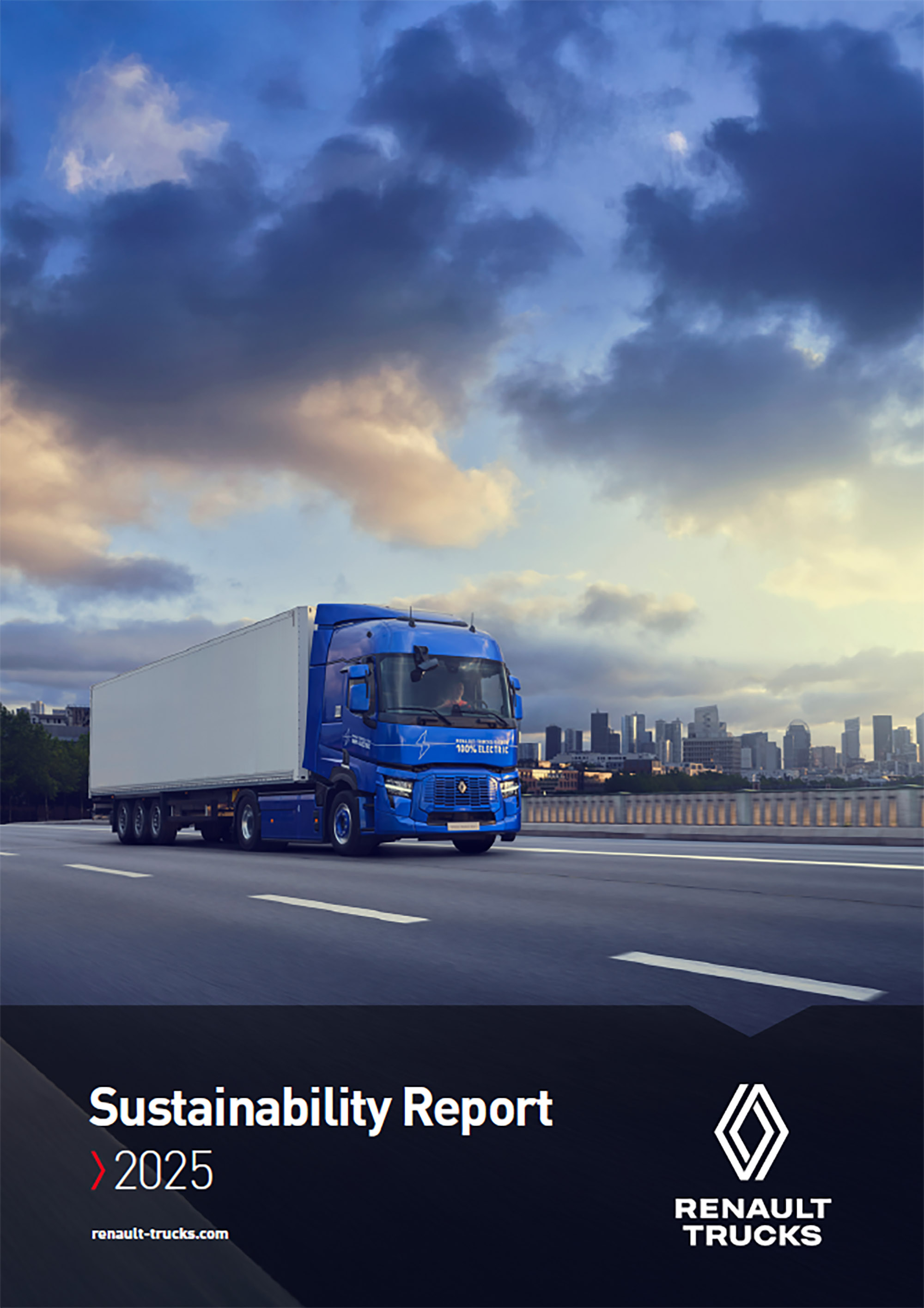
Renault Trucks has built a sustainable development model that takes into account economic, social and environmental issues in a balanced way.. In all its activities, Renault Trucks is committed to reducing its impact on the climate, using resources and conducting its business in the most responsible way.
Renault Trucks 2025 Sustainability Report illustrates a vision of the future shared by all the company's employees, as well as concrete initiatives to transform the road transport industry.
Download the free Renault Trucks' Sustainability Report 2025